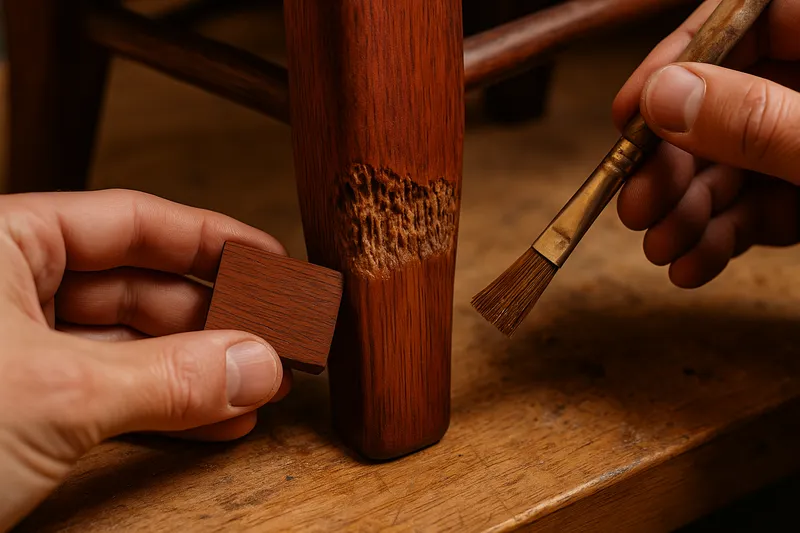
Pet damage furniture repair in Saint Paul, MN is quieter work than most people expect, and Dale’s Furniture Refinishing has been doing it by hand for over 40 years. Puppies chew chair legs. Cats find the one table leg with the best texture and stay with it. An older dog has an accident against an antique dresser and nobody notices until the wood has gone dark. None of that means the piece is finished, and none of it means you did anything wrong. Dale rebuilds chewed wood, repairs scratched finishes, and treats stained wood for pet owners throughout Saint Paul and the Twin Cities.
How we repair pet damage
Chewed wood gets cut back to sound material first. Dale trims away the crushed, splintered fibers a dog leaves behind, then splices in matching stock and shapes it back to the original profile by hand. On a turned leg or a carved corner that means recreating the shape so it flows into the rest of the piece rather than just filling a hole. Rails, stretchers, corners, and chair legs are all rebuilt the same way, and the repair is reinforced where it has to carry weight, because a chair leg needs to be safe to sit on, not only good to look at.
Scratched finishes are a different problem. Claw marks in a lacquer or varnish top are often shallow enough to sand back and re-coat, and a cat scratched table leg or cabinet stile can frequently be spot repaired. Where the scratching runs across a whole surface, or where the color has shifted with age, spot work would show, so Dale refinishes the full surface and matches the color and sheen to the rest of the piece. He tells you which one your piece needs at the estimate, not afterward.
Pet damage we repair
- Chewed legs, rails, stretchers, and case corners rebuilt with matching wood
- Cat scratched table legs, cabinet stiles, and chair posts
- Claw marks through veneer and banding
- Scratched and clouded finishes on tabletops and dressers
- Urine-stained and darkened wood on legs, feet, and cabinet bases
- Odor held in bare or previously stripped wood
- Chewed and broken chair caning seats
- Gnawed door edges and drawer fronts on cabinets
- Clawed fabric and leather, paired with upholstery work
Repair or replace a chewed leg
The honest answer depends on how much sound wood is left and on what the leg has to do. If a dog took the corners off a square leg or worked over the bottom few inches, splicing in new wood and reshaping it is usually the better repair, because the original stock, the original joinery, and the original grain all stay in the piece. That matters most on antiques and on anything where four legs need to look like they came from the same tree.
When a leg is chewed through, cracked up into the joint, or hollowed out to the point that it will not carry weight safely, Dale makes a new one and matches it to the other three in shape, wood, and color. On a turned or carved leg that is real bench work, and it is still almost always cheaper than replacing the piece. Either way the goal is the same, which is a repair you stop noticing after a week.
Why choose Dale’s for pet damage repair
- Chewed wood rebuilt, not just filled so the repair holds up
- Matched wood, stain, and sheen so the fix disappears into the piece
- Honest advice on spot repair versus refinishing the whole surface
- No lectures, just a straight estimate and careful work
- Fair pricing with FREE estimates and work we always guarantee
- 40+ years of craftsmanship, serving the Twin Cities since 1975
Stains, odor, and when to refinish
Urine is the hardest of the pet problems, because it soaks in rather than sitting on top of the finish. On a sealed surface that caught it early, cleaning and re-coating is often enough. Where it went through to bare wood and darkened it, the finish has to come off so the wood underneath can be treated, lightened back toward its original color, and refinished. That is furniture stripping and refinishing work, and it is the only approach that reliably removes the odor along with the stain. Dale will tell you at the estimate whether a given piece is worth taking that far.
Call Dale at (651) 748-9465 for a FREE estimate, or contact us here. Pet damage work usually overlaps with furniture repair, furniture refinishing, and antique restoration, and current pricing is on the site. Dale serves Saint Paul, Minneapolis, and the surrounding Twin Cities.