Wet Furniture: What to Do in the First 48 Hours
· Dale's Furniture Refinishing
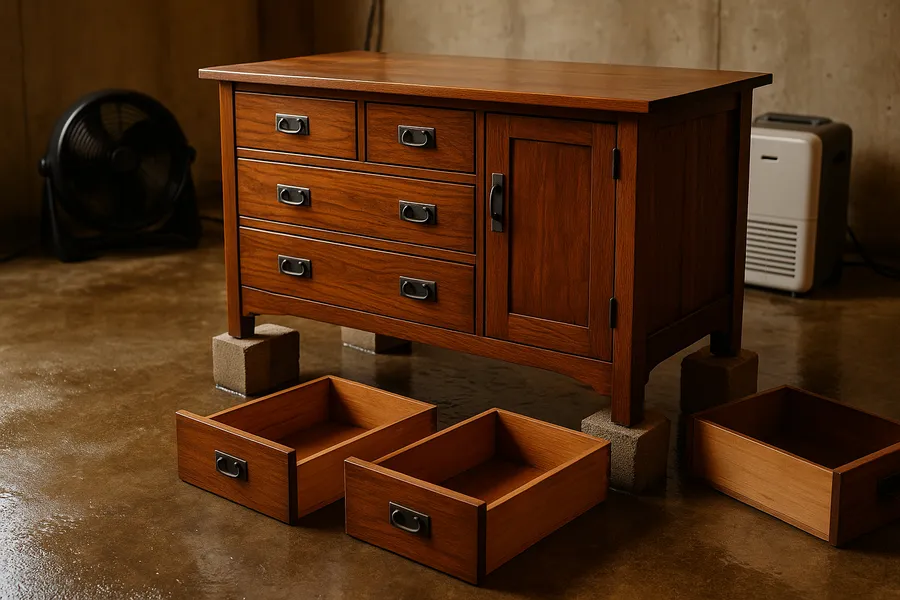
If your basement took on water last night, or a pipe let go while you were at work, the clock is the whole story. What you do in the next two days usually decides whether a piece is a repair or a loss, and most of it costs nothing but time and muscle. Over 40-plus years, the basement pieces that came back best were the ones somebody got out of the water early and then let dry slowly. The ones that did not make it got dried too fast.
The First Few Hours: Photograph It, Then Get It Out of the Water
Before you move anything, take pictures. That is the regret I hear most often, and it surfaces months later when a claim is being settled and nobody can show what the room looked like.
- Photograph everything before you touch it. Wide shots of the room, close-ups of each piece, the water line on the legs. A photo of a piece dripping in place is worth more than one taken after you hauled it upstairs.
- Get pieces up out of the water. Blocks of scrap, bricks, upturned bins, whatever you have. You want air underneath and no wicking from below.
- Get them off wet carpet too. Carpet and pad hold water against feet and legs for days and pull it up into the wood.
- Pull the drawers, doors, and loose parts. Air has to reach every face of every board. A closed case dries on the outside and stays soaked inside.
- Empty the contents. Linens and papers hold water against the wood and start smelling within a day.
- Wipe standing water off, do not scrub. Blot with towels. A wet finish is soft, and scrubbing scratches a surface that might have needed nothing.
Day One: Move Air, Not Heat
Once the pieces are up and open, your job is gentle, steady air movement. Fans running across the room rather than at the furniture, a dehumidifier emptied often, windows cracked if the weather is dry and cool, which in a Minnesota August it often is not.
Here is the part that costs people their furniture, so let me give you the why. Wood gives up moisture from the outside in. Force it with heat and the outer layer shrinks hard while the core is still wet and full size. The surface ends up stretched over something bigger than itself, and it has to go somewhere. That is where checking, splits with the grain, cupped tops, and joints pulled wide open come from.
This matters most when a remediation crew is drying your house. Their heaters and blowers are sized to dry a building, which is right for framing and drywall. Furniture in that airstream frequently cracks. Ask them to keep it out of the direct path, or move the pieces you care about out of the building.
What Not to Do
- Do not set it out in the sun. The most uneven drying there is, and it will check a top in an afternoon.
- Do not aim a space heater or blower at it. Air moving through the room is fine. Air blasting one face of a board is not.
- Do not stack wet pieces. You trap moisture between them, and softened finishes stick together and pull off when you separate them.
- Do not wrap anything in plastic. It feels protective and it is the worst thing you can do. You will have mildew in two days.
- Do not force a swollen drawer or door. It is not stuck, it is bigger than its opening. Yank on it and you break the joint.
- Do not re-glue or clamp anything yet. Glue will not hold on saturated wood, and clamping a swollen part locks in a shape it will not keep.
Day Two: What You Are Going to See
By the second day pieces start showing what the water did. Most of it looks alarming and is ordinary water damage furniture restoration work.
- Joints going loose. Old hide glue lets go when it gets wet, and modern glues fail too. That is good news. The piece comes apart, gets cleaned of the old adhesive, and is re-glued square, which is normal furniture repair work.
- Veneer lifting and bubbling. The glue under older veneer is water soluble, so it releases and the veneer rises. Fresh glue goes underneath and it is pressed flat, or patched with matching stock. Routine veneer repair.
- A white, cloudy bloom. That milky look is moisture trapped in the coating, not damage to the wood, and a light bloom can often be drawn back out. More on those in my post on fixing water rings and heat marks.
- Dark staining. Dark marks mean water reached the wood fibers. Those do not wipe out, but they strip and refinish.
- Cupped and warped tops. A curled top is not scrap. Once the wood stabilizes it can usually be flattened and refinished.
- Swollen particle board. Edges puffing and crumbling is the one thing here that does not come back.
What Usually Survives, and What Usually Does Not
Solid wood is forgiving. Given time to dry properly it nearly always makes it, and dovetailed cases, solid frames, and veneer over a solid or plywood core are normally savable. A piece can look ruined and still come back completely.
A few specifics I get asked about. Cedar chests are almost always solid wood and almost always stored in the basement, so they are a common casualty and a common save, and cedar chest refinishing covers the swollen lid, loose joints, and musty interior together. Mid-century pieces need attention early, because the factory veneer on them is thin and lifts easily, which is much of what mid-century modern restoration deals with. A piano in a flooded basement is a real project rather than a hopeless one, and the case and finish are restorable through piano refinishing, though the action and strings are a technician’s call.
What does not survive: particle board and MDF swell, lose their grip on screws, and crumble. Upholstery foam and stuffing that sat wet do not come back either, because you cannot reliably dry the inside of a cushion. The frame underneath is often perfectly fine though, and a solid frame plus new upholstery is a real option. Anything that sat in sewage or contaminated water is its own category, and I would not put a porous soft good back in a house after that.
Mold, and Where My Job Ends
Let me be plain here. Surface mildew and musty odor on wood and inside drawers get cleaned up during restoration, and stripping takes off the affected finish, so ordinary basement must is handled. I am not a mold remediation contractor and I do not do structural drying or air quality work. Heavy growth or a whole-house problem is a remediation company’s job, and I work alongside whoever you hire.
Why This Keeps Happening in Minnesota Basements
The calls follow the calendar here. Pipes freeze and split in January, then let go when they thaw. Ice dams back water up under the shingles and it comes down inside a wall. Spring melt and summer storms fill basements, and a failed sump pump does it in minutes.
What makes it sting is where we store things. The basement is where families keep the pieces they are not using but will not part with, which is why the soaked piece is so often grandma’s dresser rather than something from a box store. For the slower damage the rest of the year, see my post on caring for wood furniture through Minnesota winters.
If You Are Filing an Insurance Claim
Photos before anything moves, and that is worth saying twice. Report the loss to your carrier first, keep a written list of every affected piece, and hold onto the damaged parts until the adjuster has seen them. I provide a written, itemized estimate you can hand over, and our insurance restoration page walks through that side of it.
On coverage I will not guess for you. Whether a loss is covered, and to what limit, depends on your policy and your carrier. Ask your adjuster and get the answer in writing.
Send Me Photos Before You Give Up on a Piece
Wet furniture almost always looks far worse than it is. Swollen, loose, blotchy, and lifting are the normal appearance of a piece that is going to be fine. The ones I genuinely cannot save are usually the ones that got dried too fast.
Call me at (651) 748-9465, stop by the shop at 622 Como Ave #1 in Saint Paul, or send a few photos through the contact page for a free estimate. Tell me how long it sat, whether the water was clean, and what the piece is made of, and I can usually tell you over the phone whether it is worth bringing in. If it is, water damage restoration is a good part of what I do.