Water damage furniture restoration in Saint Paul, MN comes down to two things: how the piece dries, and how carefully it goes back together afterward. A flooded basement, a burst pipe, an ice dam, or a slow leak under a sink can swell joints, lift veneer, cloud a finish, and cup a tabletop, and none of that means the furniture is finished. Dale’s Furniture Refinishing has 40+ years of experience bringing water-damaged wood back for homeowners across Saint Paul and the Twin Cities.
How we restore water damaged furniture
Everything starts with getting the piece stable. Soaked furniture has to dry slowly and evenly at normal room conditions before any repair work happens, because wood that is still moving will not hold a joint or a finish. Dale pulls the drawers, takes off hardware, and opens up backs and undersides so air reaches the trapped surfaces where moisture and musty odor sit longest. Surface mildew and staining get cleaned at this stage, while the piece is apart and reachable.
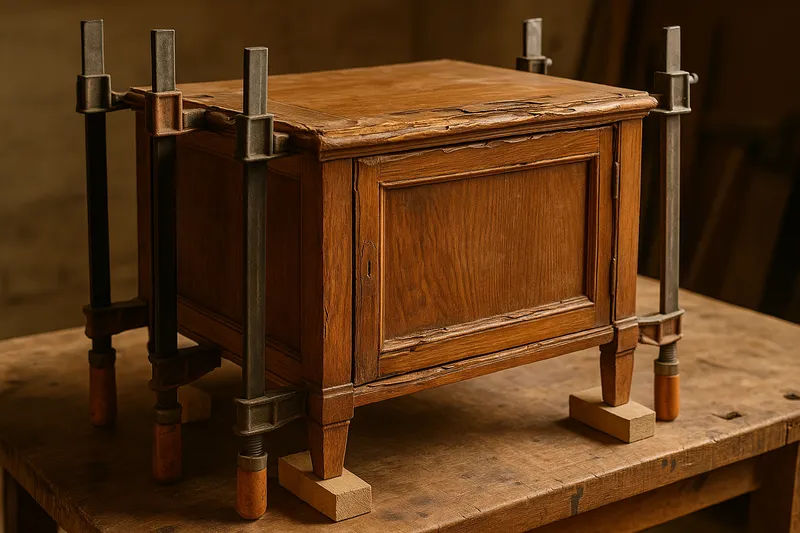
Once the wood has settled, the repairs begin. Both old hide glue and modern glues let go when they get wet, so joints usually need to be knocked apart, cleaned of the failed adhesive, and re-glued and clamped square. Veneer that lifted or bubbled gets fresh glue worked underneath and pressed flat, and missing sections are patched with matching stock. Then the finish. A light white bloom can sometimes be drawn back out, but a top that has gone milky end to end is stripped and refinished, which is also the point where warped and cupped boards get flattened and brought back true.
Water damage we handle
- Swollen, separated, and loose joints on chairs, tables, and case pieces, handled as furniture repair
- Lifting, bubbling, and peeling veneer, handled as veneer repair
- White blooming and blushed, milky finishes
- Water rings, dark stains, and raised grain
- Warped, cupped, and twisted tops, common in dining table refinishing
- Swollen drawers, drawer bottoms, and case backs, common in dresser refinishing
- Surface mildew and musty odor in drawers and cabinet interiors
- Sink, dishwasher, and supply line leaks under kitchen cabinets
- Water damaged heirlooms that need full antique restoration
Why fast drying ruins wood
The instinct after a flood is to dry everything as fast as possible, and for carpet and drywall that is correct. For furniture it is the quickest way to destroy a piece that would otherwise have survived. Wood gives up moisture from the outside in. Force it with a space heater, a blower pointed straight at it, or a few afternoons in the sun, and the outer layer shrinks hard while the core is still wet and full size. What you get is checking, splits running with the grain, cupped and twisted tops, and joints pulled further apart than the water left them.
Dale dries pieces slowly at room temperature with air moving around them rather than at them, and waits for the wood to stabilize before gluing or finishing anything. It takes longer, and it is frequently the difference between a repairable piece and firewood. If a remediation crew is drying out your house, ask them to keep furniture out of the direct path of the heaters and blowers, or get the pieces you care about out of the building.
What survives water and what does not
Solid wood is forgiving. Given time to dry properly it nearly always comes back, and swollen joints, raised grain, and a wrecked finish are all repairable. Veneered furniture over a solid or plywood core is usually savable too, since veneer can be re-glued or patched. Particle board and MDF are the exception. Once they take on water they swell, lose their grip on screws and fasteners, and crumble, and nothing shrinks them back, so flat-pack furniture that sat in a flooded basement is generally a loss.
Mold deserves a plain answer. Dale cleans surface mildew and musty odor off wood and out of drawers as part of restoration, and stripping removes the affected finish. He is not a mold remediation contractor and does not do structural drying or air quality work. Heavy growth, mold in upholstery stuffing, or a house that needs remediation is a job for a remediation company, and Dale is glad to work alongside the one you hire.
Why choose Dale’s for water damage restoration
- Controlled, slow drying instead of forced heat that splits wood
- Joints re-glued properly, not clamped over failed adhesive
- Veneer, warping, and blushed finishes all handled in one shop
- Written, itemized estimates for your insurance adjuster
- We always guarantee our work
- 40+ years of craftsmanship, serving the Twin Cities since 1975
Water damage in a Minnesota house
Most of the water-damaged furniture that reaches the shop traces back to the same short list of Minnesota problems. Pipes freeze and split in January, then let go when they thaw. Ice dams back water up under the shingles and it comes down inside a wall onto whatever is standing against it. Spring melt and heavy summer storms put water in basements, and a sewer backup or a failed sump pump does it in minutes. Basements are also where people store the furniture they are not currently using, which is why the piece that gets soaked is so often an heirloom rather than something replaceable.
Call Dale at (651) 748-9465 for a FREE estimate, or contact us here. If the same loss involved fire or smoke, see fire and smoke damage furniture restoration, and if you are filing a claim, start with insurance restoration. Water work usually pairs with veneer repair and furniture repair, and current pricing is on the site. Dale serves Saint Paul, Minneapolis, and the surrounding Twin Cities.