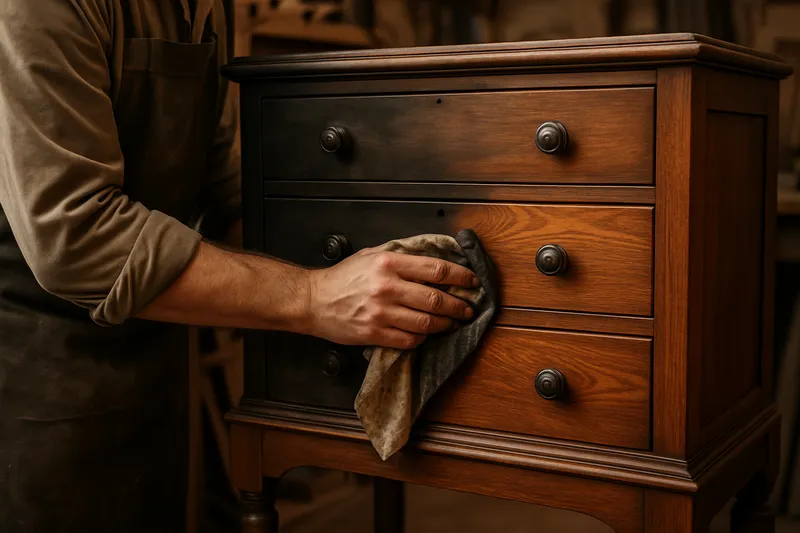
Fire and smoke damage furniture restoration in Saint Paul, MN starts with an honest look at what is actually ruined and what only looks ruined. After a house fire, a great deal of solid wood furniture goes to the curb that a craftsman could have brought back. Dale’s Furniture Refinishing has spent 40+ years working on damaged wood, long enough to tell the difference at a glance, and Dale cleans, deodorizes, repairs, and refinishes fire- and smoke-damaged furniture for homeowners throughout Saint Paul and the Twin Cities.
How we restore fire and smoke damaged furniture
The first job is getting the residue off. Soot is not ordinary dirt. It is a greasy, acidic film that smears if you wipe it wrong and drives itself deeper into open grain and old finish. Dale lifts the residue rather than scrubbing it, works it out of carving, molding, hardware, and drawer interiors, then looks at what the heat did to the finish underneath. Often the original finish has absorbed the worst of it and the wood below is still clean and sound, which is exactly the case where furniture stripping and a fresh finish bring a piece all the way back.
With the surfaces clean, Dale turns to structure. Heat and the water used to put a fire out both let glue joints go, so chairs, tables, and case pieces frequently need to come apart and be re-glued square. Scorched edges are cut back and repaired, blistered or lifted veneer gets fresh adhesive worked underneath and clamped flat, and the piece is then stripped and refinished so color and sheen are consistent across the whole surface. Odor is dealt with at each stage rather than at the end, because smoke smell that has only been covered up comes back.
Fire and smoke damage we handle
- Soot, ash, and greasy residue on wood, finish, and hardware
- Smoke odor trapped in drawers, cabinet interiors, and unfinished backs
- Heat-blistered, bubbled, and crazed finishes
- Scorched and lightly charred edges, corners, and feet
- Yellowed, clouded, and discolored finishes from heat and smoke
- Joints loosened by heat and by fire hose water, which is furniture repair work
- Veneer that lifted or bubbled in the heat, handled as veneer repair
- Smoke-damaged heirlooms that need full antique restoration
- Cabinet doors and frames sooted by a stove or grease fire, refinished like any kitchen cabinet job
What can and cannot be saved
Solid wood is tougher than people expect. Smoke and soot sit on the surface, and the finish acts as a sacrificial layer, so an oak dresser or a walnut dining table that looks black and hopeless is very often a cleaning, stripping, and refinishing job instead of a loss. Older furniture also tends to be built from thicker stock with real joinery, which leaves Dale material to work with when he has to cut back a scorched edge or replace a run of trim.
What does not come back is wood that burned rather than scorched. Once char runs deep into a leg, a rail, or a tabletop, the strength is gone and there is nothing left to refinish. Particle board and MDF furniture that got soaked by fire hoses swells, loses its grip on fasteners, and crumbles, and it is rarely worth the labor. Upholstery that absorbed heavy smoke normally needs new fabric and foam rather than cleaning, though the frame underneath is often perfectly good, which is where upholstery work comes in. Dale sorts pieces into those groups up front rather than taking on work that will not deliver.
Why choose Dale’s for fire and smoke damage restoration
- Honest assessment first, so you never pay to restore something that cannot be saved
- Soot and odor treated at the wood, not covered over with a fresh coat
- Hand cleaning, repair, and refinishing by one experienced craftsman
- Written, itemized estimates you can hand straight to your adjuster
- We always guarantee our work
- 40+ years of craftsmanship, serving the Twin Cities since 1975
Why soot gets worse the longer it sits
Soot keeps working after the fire is out. Left on a finish it etches and dulls it, and on brass and steel hardware it pits and corrodes. Smoke odor keeps migrating into raw wood on drawer bottoms, case backs, and the undersides of tops, and the longer it soaks, the more surface has to be opened up to get it out again. A piece brought in during the first weeks after a fire is usually a cleaning and refinishing job. The same piece six months later can need considerably more work for the same result, so it is worth getting an estimate early even while the claim is still moving.
Call Dale at (651) 748-9465 for a FREE estimate, or contact us here. If your loss involved water as well as fire, see water damage furniture restoration, and if you are filing a claim, insurance restoration covers what your adjuster will want. Fire work usually includes furniture repair and full furniture refinishing, and current pricing is on the site. Dale serves Saint Paul, Minneapolis, and the surrounding Twin Cities.