Mid-Century Modern: Restore, Don't Replace
· Dale's Furniture Refinishing
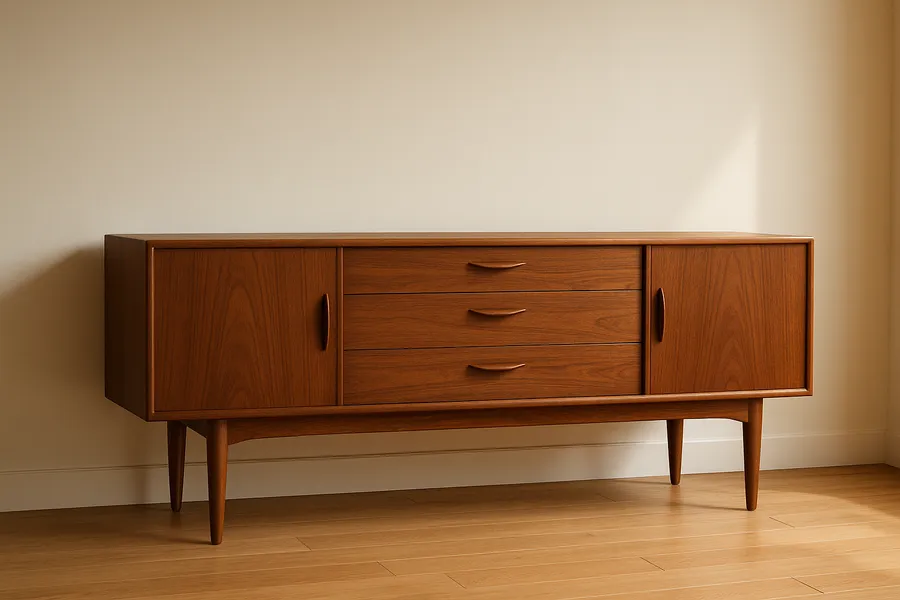
Somebody walks into my shop about once a week holding a phone with a photo of a low teak credenza on it. Usually it came out of a parent’s house, or they spotted it at an estate sale over in Highland Park and paid next to nothing for it. The finish looks dried out and gray, there’s a water ring on the top, and one leg wobbles. And almost every time the question is the same: “Is this thing even worth fixing, or should I just buy something new?”
I’ll answer that right up front, the same way I answer it in the shop. Yes. It is almost always worth fixing. These mid-century pieces were built better than what you can buy new today, and a tired one that looks like a lost cause is usually a good afternoon of work away from being beautiful again. Restore it. Don’t replace it.
Why the Twin Cities are full of this furniture
There’s a reason you trip over mid-century modern (MCM) furniture at every estate sale from Saint Paul out to the western suburbs. After the war, the metro grew fast. Whole neighborhoods went up in the 1950s and 1960s, ramblers and split-levels all across Ramsey and Hennepin counties, and people needed furniture to fill them. Clean-lined, low-slung, no fuss.
That style landed especially well up here because it fit how we already lived. A lot of families in this area have Scandinavian roots, and the Danish modern look, the warm oiled teak, the simple honest joinery, felt like home. So the furniture sold, and people kept it. Sixty years later it’s still sitting in basements, spare rooms, and lake cabins all over the region.
What that means for you is simple. Teak and walnut credenzas, oak dressers, and dining sets show up around here constantly, often for very little money, because the person selling doesn’t always know what they’ve got. You do now.
Why you restore it instead of replacing it
Here’s the honest case for keeping the old piece.
- It’s actually solid. Much of this furniture is real hardwood, or a good hardwood veneer over a solid wood core, joined properly. Pick up a mid-century dresser drawer and you’ll often find dovetails and wood that runs true. That’s not what you get in a flat-box off the store floor today.
- You can’t buy the look new for the same money. A new piece with genuine teak or walnut and this kind of construction costs real money. The one you already own just needs work, not a four-figure replacement.
- The value is going up, not down. Good MCM has been climbing for years. A well-kept original piece holds its worth in a way a new particleboard cabinet never will.
I’ve written more on this at why an old piece is usually worth restoring instead of buying new, because it isn’t just an MCM thing. But with mid-century furniture the math is especially lopsided in favor of restoring.
How MCM restoration is different, and where people go wrong
This is the part I most want folks to hear, because good intentions ruin more of these pieces than neglect does.
Mid-century furniture cannot be treated like a beat-up old dresser you just sand down to bare wood and re-coat. It needs a lighter, more respectful hand. Here’s why.
The veneer is thin
A lot of MCM uses a thin sheet of teak or walnut veneer over a solid core. And I mean thin. Somebody rents a power sander, gets after that gray top with too much muscle, and sands clean through the veneer into the substrate underneath. Once that happens there’s no fixing it, you can’t put the wood back. So on these pieces I sand carefully, by hand where it counts, or often I don’t aggressively sand at all.
A lot of it is an oil finish, not a film finish
Much of this furniture was finished with a penetrating oil (Danish oil is the common one) that soaks into the wood rather than sitting on top like a lacquer or a polyurethane. That kind of finish is meant to be revived, not stripped off. Nine times out of ten a dried-out teak top doesn’t need stripping and refinishing at all. It needs a good cleaning and fresh oil worked back into it, and it comes right back to life. Stripping it and slapping a plastic-looking film coat on top is the wrong move and it looks wrong too.
Over-restoring can cost you value
With collector pieces, making it look brand new can actually hurt what it’s worth. Buyers of good mid-century want an honest, original piece with an honest finish, not something that’s been sanded down and refinished within an inch of its life. I go into this more in whether refinishing an antique or vintage piece hurts its value. The short version: do the least that gets the job done well.
The work these pieces usually need
Most mid-century jobs that come through my door fall into a handful of buckets:
- Reviving a tired oil finish. Cleaning off decades of grime, lifting water rings and haze, and feeding fresh oil back into dry teak or walnut. This is the most common one, and the most satisfying, because the wood just wakes up.
- Careful refinishing when it’s truly needed. Some tops are too far gone for a simple revive, and then I refinish, but gently, mindful of that thin veneer. My dresser refinishing work covers a lot of these mid-century dressers and credenzas.
- Re-gluing loose joints. Sixty years of dry Minnesota winters loosen things up. Wobbly legs, racking cases, and loose stretchers get taken apart, cleaned, and glued back properly so the piece is solid again.
- Reupholstering the seats. MCM chairs are famous for their foam-and-fabric seats and cushions, and after this many years the foam is usually shot and the fabric is worn or dated. New foam and fresh fabric on those clean frames makes an enormous difference. That’s where upholstery comes in, and it’s often the finishing touch on a dining set or a lounge chair.
Respect the piece
If there’s one thing I want you to take from all this, it’s that a good mid-century restoration respects the original design and the original finish. The goal isn’t to make a 1962 credenza look like it rolled off a truck yesterday. The goal is to make it look like a well-cared-for 1962 credenza, clean lines, warm oiled wood, honest and solid, ready for another sixty years. That’s the difference between restoring a piece and erasing it.
Bring it in for a free look
If you’ve got a mid-century piece and you’re not sure whether it needs a simple revive or a full restoration, bring it by or send me a photo. I’ll tell you straight what it needs and what it doesn’t, and I won’t talk you into work that isn’t necessary. Our mid-century modern furniture restoration page walks through how I handle thin factory veneer and original oil finishes, which is where most of these pieces get ruined by well-meaning sanding.
Call me at (651) 748-9465, or stop by the shop at 622 Como Ave #1 in Saint Paul. You can also reach me through the contact page to set up a free assessment. Forty-plus years of doing this, and these old teak and walnut pieces are still some of my favorite work.