Refinishing vs. Buying New Furniture: Worth It?
· Dale's Furniture Refinishing
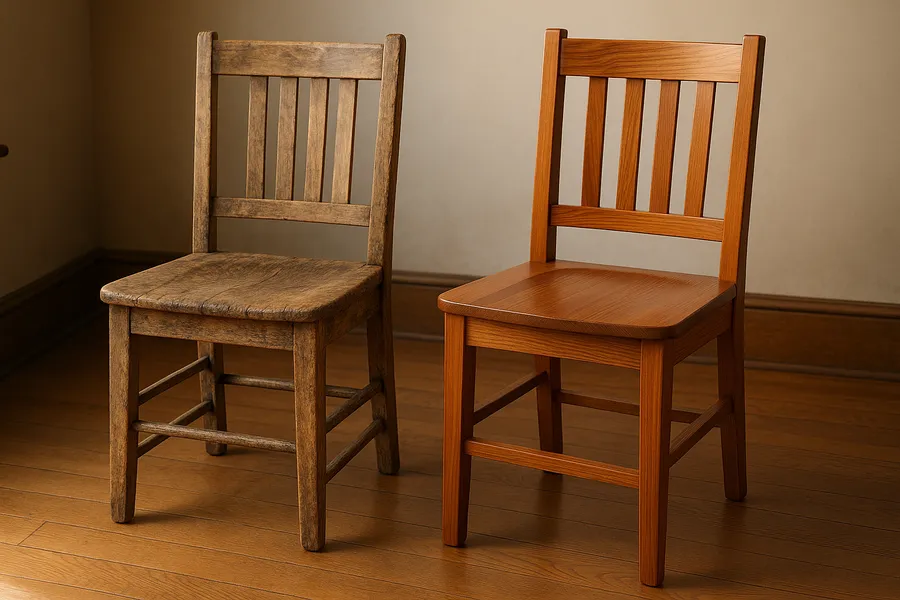
Sooner or later, every piece of wood furniture reaches a crossroads. The finish is worn, there’s a water ring on the top, a joint has gone wobbly, and you’re standing there wondering whether to haul it to the curb and buy something new or call someone like me to bring it back to life.
After more than 40 years refinishing furniture in Saint Paul, I’ve helped a lot of people make that decision. The honest answer is that refinishing isn’t always worth it, but more often than people expect, it is, and for reasons that go well beyond money. Let’s walk through how to think it through.
Old Furniture vs. New Furniture: A Quality Gap
The single biggest thing people don’t realize is how much furniture quality has changed. Walk through most furniture stores today and a lot of what you’ll find, even at mid-range prices, is built from particleboard or MDF with a thin veneer or a printed wood-look surface. It’s assembled with staples and cam-lock fittings, and it’s designed to look good in a showroom, not to last 50 years.
The dresser your grandmother owned, or that table you found at an estate sale, was very likely built differently:
- Solid hardwood or quality veneer over solid cores, not particleboard.
- Real joinery like dovetailed drawers and mortise-and-tenon joints that can be repaired rather than replaced.
- Thicker stock that can be sanded and refinished multiple times over its life.
- Hardware that was made to be serviced, not thrown away.
That’s why an old piece in rough shape is often a better candidate for investment than a new piece in perfect shape. You’re starting with better raw material. Refinishing simply renews the surface of something that was built to endure.
Is Furniture Refinishing Worth It? The Cost Comparison
Let’s talk money, because that’s usually where the decision starts. The question to ask isn’t just “what does refinishing cost?” It’s “what would it cost to replace this with something of equal quality?”
When you compare refinishing against buying a genuinely comparable solid-wood piece new, refinishing frequently comes out ahead. A new solid-hardwood dining table built with real joinery can run well into the thousands. Refinishing the one you already own is typically a fraction of that.
Where the math changes is when you’d be replacing an old piece with inexpensive new furniture. If the alternative is a flat-pack dresser, the dollar comparison is closer, but then you’re trading a repairable solid piece for a disposable one. Refinishing cost varies by piece and condition, so the smartest move is to get a free estimate and compare it against what you’d actually spend to replace it.
Sustainability: Restore, Don’t Replace
There’s a quiet environmental case for refinishing that I’ve watched more customers care about over the years. Furniture manufacturing consumes lumber, energy, and shipping fuel, and discarded furniture is a significant source of landfill waste. A solid wood piece that gets refinished instead of tossed keeps usable hardwood in service for decades longer.
Restoring what you already own is about the most sustainable furniture choice there is:
- No new trees harvested for a replacement.
- No manufacturing or overseas shipping footprint.
- One less bulky item in the landfill.
- A finish renewed with the right materials rather than a whole object discarded over a surface problem.
“Restore, don’t replace” isn’t just a nice slogan. For solid wood furniture, it’s usually the responsible choice.
The Value You Can’t Put a Price On
Some of the most rewarding work we do has nothing to do with dollars. It’s the dining table where three generations have eaten Thanksgiving dinner. The rocking chair a customer was rocked in as a baby and now uses with their own grandchild. The desk a parent left behind.
You can’t buy that at a store. New furniture, however nice, doesn’t carry your family’s history. When a piece has sentimental value, the question isn’t really “is it worth it?” It’s “can it be saved?” And the answer is usually yes. Even badly damaged heirlooms can often be brought back through careful antique furniture restoration, which is some of my favorite work precisely because it means so much to the people who own these pieces.
When Refinishing Makes Sense, and When It Doesn’t
To keep it practical, here’s how I’d sort it out.
Refinishing is usually worth it when:
- The piece is solid wood with sound construction.
- The joinery is good or repairable.
- It has sentimental or family value.
- A comparable new piece would be expensive.
- You genuinely like the piece and want to keep using it.
Refinishing may not be worth it when:
- It’s cheap particleboard or laminate with no solid wood to work with.
- The damage is so extensive that repairs exceed the piece’s value and meaning.
- You don’t actually like the piece and are only keeping it out of obligation.
I’ll always give you my honest read. If a piece isn’t worth refinishing, I’ll tell you, because my reputation in this community matters more than any single job. And if it is worth saving, our furniture refinishing service can make it look and function like new again.
Not Sure? Let’s Take a Look
If you’re on the fence, the easiest next step is to let a craftsman look at the piece and give you a straight assessment. We’ll tell you what it would take, roughly what it would cost, and whether we think it’s worth doing.
Call us at (651) 748-9465, visit the shop at 622 Como Ave #1 in Saint Paul, or send a few photos through our contact page for a free estimate. Whatever you decide, you’ll be making an informed choice about a piece that clearly matters to you.