Veneer Damage: Repair or Replace?
· Dale's Furniture Refinishing
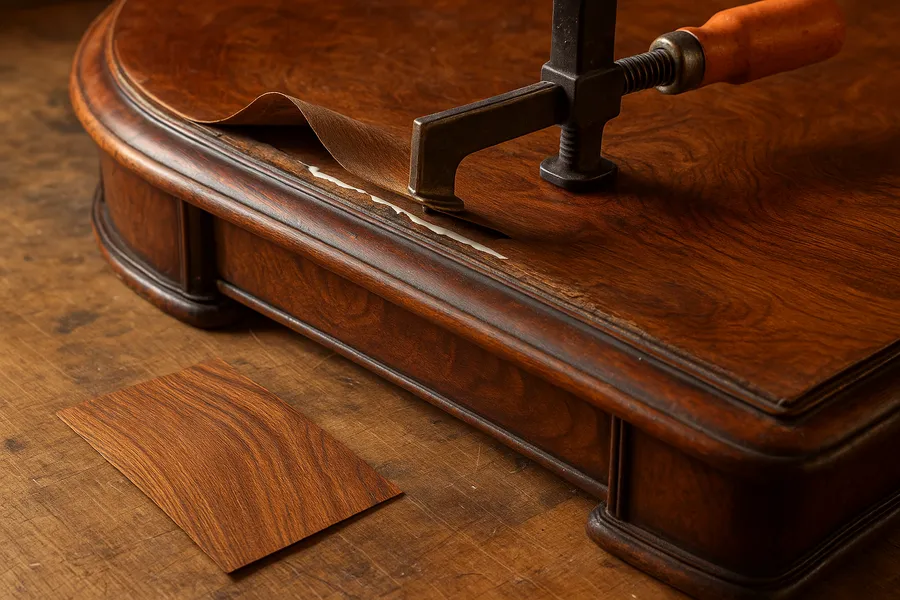
The moment people spot a lifting corner or a bubble on a tabletop, they usually say the same thing: “Oh, it’s just veneer, it’s not worth fixing.” I hear it in the shop all the time, and it’s one of the most common mistakes people make about their own furniture. Over my 40-plus years working on furniture here in Saint Paul, I’ve saved countless pieces that owners had already written off as junk, all because of that one word, veneer. So let’s clear it up. Veneer damage is usually very repairable, and the piece under it is almost always worth saving.
What Veneer Actually Is
Veneer is a thin layer of real wood bonded over a stable core underneath. That’s the whole idea. It is not plastic, it is not a photograph of wood printed on particleboard, and it is not a sign of cheap construction. It is genuine hardwood, sliced thin and glued down over a solid foundation.
Here’s the part that surprises people: fine antique and quality furniture has always used veneer, and often the best pieces use the most of it. A skilled maker reaches for veneer precisely because it lets him show off the most beautiful wood there is. Think about burl, crotch grain, and carefully matched book-matched panels. Those figured woods are gorgeous, but they come from unstable parts of the tree, knots, crotches, and stumps, and they would crack, warp, or split apart if you tried to build a whole tabletop out of them in solid form. Slicing that figure into veneer and laying it over a stable core is the only way to use it at all.
So when you see a stunning grain pattern on an old dresser or a piano, you are usually looking at veneer, and that veneer is the reason the piece is beautiful. Veneered does not mean low quality. In a lot of cases it means the opposite.
The Common Damage Types, and Whether They Can Be Saved
Most veneer trouble falls into a handful of categories, and I can tell you the good news up front: the great majority of it is fixable. Here is how I sort it out when a piece comes into the shop.
- Lifting or loose veneer and bubbles or blisters. This is the most common problem and one of the easiest to fix. Over the years the old glue underneath dries out and lets go, so the veneer stops holding tight to the core. It lifts at an edge or puffs up into a blister you can press with your thumb. In most cases we work fresh glue back under the loose area, then clamp it flat until it sets. Once it’s back down and bonded, you would never know it moved. Very repairable.
- Chips and small missing pieces along edges. Corners and front edges take the bumps, so that’s where veneer chips off. We patch these with matching veneer, cutting a clean piece to fit and blending it into the surrounding grain and color. Done right, the patch disappears.
- Cracks and small losses in the field. A hairline crack or a small spot of missing veneer out in the middle of a surface gets filled or patched, depending on the size and where it sits. Small losses are routine repair work.
- Large missing areas or a badly deteriorated sheet. This is the one case that leans toward replacement. If a big section is gone, or the veneer is cracked, buckled, and failing across a whole panel, the smart move is often to re-veneer that panel with fresh stock rather than chase a hundred little repairs.
The honest bottom line is that repair is usually possible and almost always the better call. Even when the veneer on top is rough, the frame and structure underneath, the legs, the joints, the drawers, are typically solid and well worth saving. That old piece was built to last, and the damage you’re looking at is almost always surface deep.
The One Big Risk With Veneer
Here is the warning I give everybody, and it’s the reason veneer work trips up well-meaning do-it-yourselfers. You cannot sand veneer the way you sand solid wood.
Solid lumber lets you sand aggressively, dig out scratches, and keep going. Veneer is thin, sometimes only a fraction of a millimeter after decades of prior refinishing. If you take a power sander to it, you will cut right through that thin layer and expose the core underneath, and once you’ve sanded through, there is no putting it back. That spot is done. This is exactly why veneered pieces need a careful hand and, honestly, why they’re often best left to a pro who knows how much material is really there before starting.
Repair or Replace: A Simple Way to Decide
You don’t need to be an expert to get a feel for which way a piece is likely to go. Here is the plain-language version of how I think about it:
- Repair when the veneer is mostly sound and the damage is local. Lifting corners, a few bubbles, chipped edges, a crack or two. That’s re-glue, clamp, and patch work, and it keeps the original wood on your piece.
- Consider re-veneering a panel when the loss is extensive or the veneer is failing across a whole surface. If a tabletop is buckled edge to edge, or big sections are simply gone, a fresh panel is the cleaner and longer-lasting answer.
Most of the pieces I see land firmly in the repair column. If you’re weighing whether the whole thing is worth the effort, I wrote more about that here: why an old piece is usually worth saving. And you can read about how we handle the fine work on our veneer repair page, along with the broader structural side on our furniture repair page for pieces that need joints tightened before the surface is touched.
Bring It In for a Free Look
If you’ve got a table, dresser, or piano with veneer that’s lifting, chipped, bubbled, or missing, don’t throw it out and don’t sand it. Let me take a look first. More often than not, it’s a straightforward save.
Call me at (651) 748-9465, stop by the shop at 622 Como Ave #1 in Saint Paul, or send a few photos through the contact page for a free assessment of the veneer. I’ll tell you honestly whether it’s a simple repair or a bigger job, and either way, that piece has a good chance of another long life.