How Much Does Piano Refinishing Cost?
· Dale's Furniture Refinishing
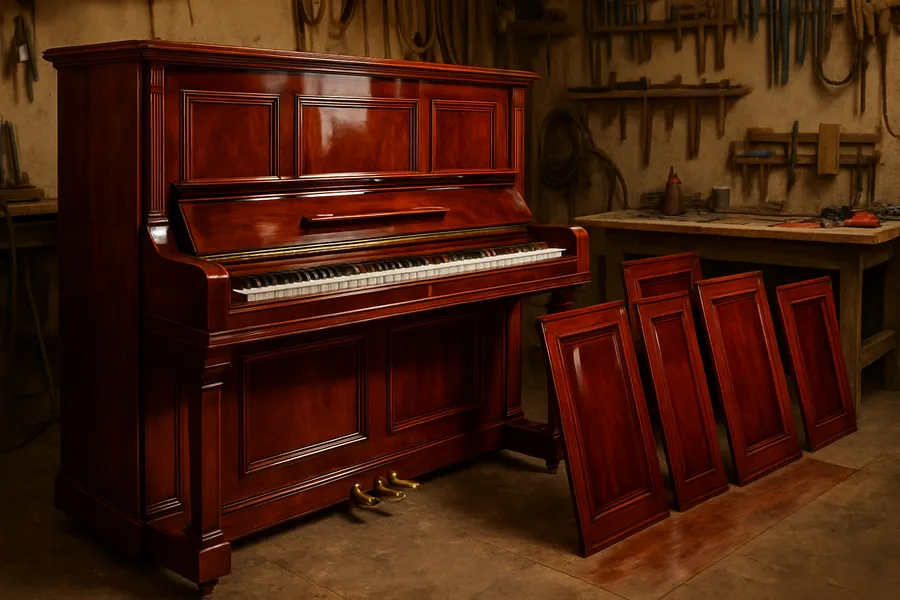
Every so often the phone rings and it’s someone standing next to a piano that’s been in the family for generations. An old upright that anchored the living room, or a grand that’s still beautiful under a finish that’s gone tired, checked, and scratched from decades of sunlight and dusting. The music is still there, but the wood looks its age. The question that follows is almost always the same: “What would it cost to bring the cabinet back?”
It’s a fair question, and after 40-plus years of refinishing furniture across the Twin Cities, I’ll give you the same honest answer I give on the phone. A piano is not a table. It’s one of the larger and more involved pieces I ever put on the bench, and the price reflects that. Let me walk you through why piano refinishing is specialized work, what moves the cost up and down, and why the only real number comes from seeing the instrument in person.
Why Piano Refinishing Is Its Own Kind of Job
When people picture refinishing, they think of a flat tabletop. A piano is nothing like that. The cabinet is a large piece of furniture with a lot of surface area and a lot of separate parts, and much of the work is in the disassembly and reassembly.
- There’s simply a lot of surface. The case, the sides, the top, the front panels, the music desk, and the legs add up to far more square footage than a typical piece of furniture.
- Many parts come off and go back on. The fallboard, the music desk, the panels, the leg and lyre assembly on a grand. Each one is finished separately and has to fit and align when it returns.
- There are edges and details everywhere. Legs, the lyre that holds the pedals, moldings, and carved trim all slow the work down. Flat areas go quickly. Detail does not.
- Old finishes behave differently. Older pianos often wore shellac or lacquer. Some newer ones came from the factory with a very hard, thick, high-gloss polyester finish that is a different animal to work with entirely. How the existing finish comes off, or doesn’t, changes the whole plan.
- The finish has to be even across all of it. Whether you want a deep high-gloss or a softer satin, achieving a consistent sheen over that much surface and that many separate panels is demanding hand work, not a quick spray-and-done.
Put all of that together and you can see why a piano is a significant project, not a quick job. It ties up bench space and takes real time from start to finish.
What I Do, and What a Piano Technician Does
This is important, so I want to be clear about it. I refinish the wood. The cabinet, the case, the visible furniture of the instrument. That’s my craft.
I do not tune pianos, rebuild the action, replace strings, or regulate the mechanism. That’s the work of a piano technician, and it’s a genuine specialty of its own. If your piano needs tuning or internal work, I’d recommend coordinating with a good piano tuner or technician for that side of it. Often the two jobs pair up nicely: get the cabinet looking like new from me, and have the technician handle the voice.
When I do the cabinet work, the mechanism stays protected. I’m careful to keep finishing materials and dust away from the internals, and on a grand the harp and strings are covered and shielded while I work the case. You’re getting a refinished piece of furniture, done with respect for the instrument inside it.
What Moves the Cost
No two pianos price out the same. Here are the factors that make the biggest difference:
- Upright versus grand. A grand is larger, has the big lid and rim, and involves the leg and lyre assembly. It’s generally more involved than an upright, and that shows up in the price.
- The current finish and how much stripping it needs. A finish that’s simply worn is one thing. Thick old lacquer, layered finishes, or that rock-hard polyester coat can mean far more stripping labor before any new finish goes on.
- Full refinish versus a revival. If the finish is mostly sound and just tired, sometimes a clean-up and touch-up brings it a long way for a lot less. A full strip-and-refinish is the bigger project. I’ll tell you honestly which one your piano actually needs.
- High-gloss versus satin. A mirror-like high-gloss requires more building, leveling, and rubbing out than a satin finish. Both are beautiful. One is more hours.
- Color or tone changes. Going lighter or shifting the tone means more stripping and sometimes extra steps, which adds time.
- Veneer repair and damage. Loose or chipped veneer, water damage, cracked trim, or missing pieces all add repair work before finishing starts.
Because those factors stack differently on every instrument, I won’t throw out a flat figure here. What I can tell you is that a full piano refinish is more than refinishing a typical table, precisely because of the surface area, the disassembly, and the detail. Anyone who quotes you a firm price sight unseen is guessing.
A Word on the Old Shellac Finishes
Many older pianos, especially fine uprights and grands, originally wore a hand-rubbed shellac finish, the same French polish tradition used on the best antique furniture. There’s a real warmth to that kind of finish, a depth that seems to come from inside the wood. If your piano has an original shellac finish worth preserving, that changes the conversation, because sometimes the right move is to honor the original rather than replace it with something modern. You can read more about that craft in my post on the hand-rubbed shellac tradition, and see how I approach it on my French polishing service page.
For the full picture of what goes into pricing refinishing work in general, my guide on what drives refinishing cost generally covers the factors that apply to any piece.
The Only Way to Price a Piano
I’ll be straight with you: pianos vary too widely for a phone quote to mean anything. The finish, the size, the condition, the wood, and what you want it to look like when it’s done all change the number. The only honest way to price yours is to see it, look at how the finish is behaving, and talk through what you’re after. That’s exactly what my piano refinishing service is built around.
If you have an upright or a grand with a finish that’s seen better days, I’d be glad to take a look. Give me a call at (651) 748-9465, stop by the shop at 622 Como Ave #1 in Saint Paul, or reach out through the contact page for a free estimate. Every piano is different, so an in-person look is the only way to price one right, and I’ll give you a straight answer about what it’ll take to bring yours back.