What Is French Polishing? Hand-Rubbed Shellac
· Dale's Furniture Refinishing
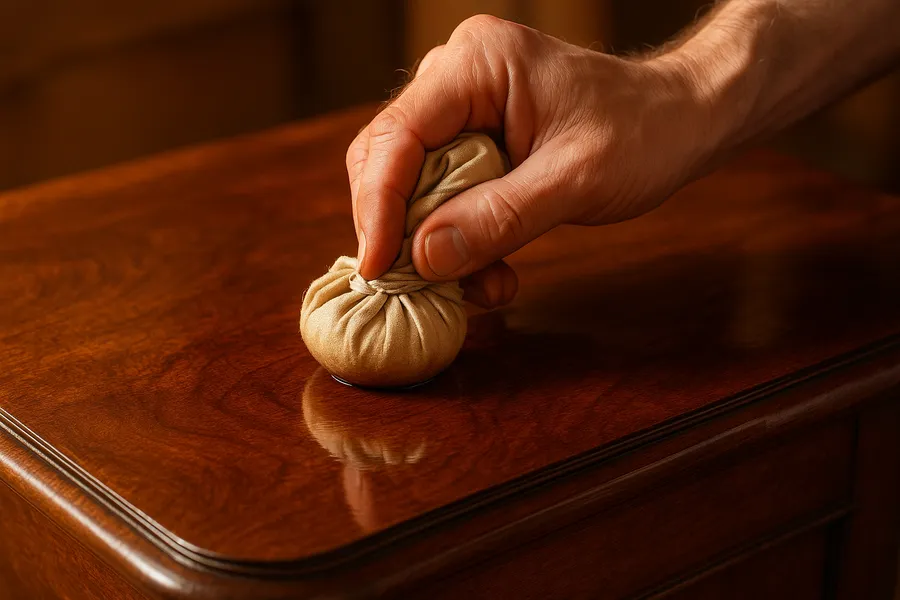
Every so often someone brings a piece into our Saint Paul shop and asks if we can match the deep, glowing finish on their grandmother’s antique table, the kind that seems to have light coming from inside the wood rather than sitting on top of it. Nine times out of ten, what they’re admiring is French polish, and it’s one of the most beautiful finishes ever developed for wood.
It’s also one of the rarest finishes you’ll find a shop still doing by hand. Let me explain what French polishing actually is, where it came from, and why so few craftsmen still offer it.
What Is French Polishing, Exactly?
French polishing is not a product. It’s a technique, a method of applying many ultra-thin layers of shellac by hand to build a finish of remarkable depth and clarity.
The work is done with a “rubber” or “pad,” which is a wad of absorbent cotton wrapped in a lint-free cloth. The pad is charged with a small amount of shellac dissolved in alcohol, and the polisher works it across the wood in continuous circular and figure-eight motions, with a few drops of oil to keep the pad gliding. Each pass leaves behind a microscopically thin film. Over dozens, sometimes hundreds of passes across multiple sessions, those layers build into a smooth, glassy surface.
What makes it special is that the finish is built into and onto the wood by hand, not sprayed or brushed on in thick coats. The result is a finish that’s thin, luminous, and almost liquid-looking, showing off the grain rather than burying it under plastic.
A Short History of the Finish
French polishing rose to prominence in the early 19th century and became the premier furniture finish of the Victorian era. Cabinetmakers across Europe used it on their finest work, and it remained the standard for high-end furniture until faster, more durable finishes like nitrocellulose lacquer arrived in the 20th century and largely pushed it aside for mass production.
Shellac itself, the heart of the finish, is far older. It’s a natural resin secreted by the lac insect, harvested and refined into flakes that dissolve in alcohol. People had used shellac for centuries, but the French polishing technique refined its application into an art form. When you see a genuinely antique piece with that warm, deep shine, you’re very likely looking at the same method a craftsman used 150 years ago.
Where French Polishing Is Used
Because it’s labor-intensive and produces a delicate finish, French polishing is reserved for pieces where appearance matters most:
- Fine antiques, where an authentic period finish preserves both beauty and value.
- Pianos, especially older grand and upright pianos, where the technique was traditional.
- High-end musical instruments, including guitars, where a thin shellac finish is prized for letting the wood resonate.
- Heirloom furniture, like dining tables, desks, and cabinets meant to be showpieces.
- Restoration work, where matching an original finish is the goal rather than replacing it with something modern.
If you own an antique with an original shellac finish, refinishing it with a modern polyurethane would actually diminish it. Maintaining or restoring the French polish keeps the piece true to itself, which is a big part of proper antique furniture restoration.
The Pros and Cons of French Polish
Like any finish, French polish involves trade-offs. It’s worth knowing them before you decide it’s right for your piece.
The advantages:
- Unmatched depth and beauty. Nothing else quite captures that warm, three-dimensional glow.
- Brings out the grain. The thin, clear film enhances figure and color rather than masking it.
- Repairable. Because it’s shellac, a damaged French polish can be reamalgamated and touched up with fresh shellac and alcohol, often invisibly. You don’t have to strip the whole piece.
- Authentic and reversible. It’s the historically correct finish for antiques and can be removed without harsh chemicals.
- All-natural materials. Shellac is a natural, food-safe resin once cured.
The drawbacks:
- Less durable day to day. It’s sensitive to heat, water, and alcohol. A wet glass or a hot dish can leave a mark, which is why it suits showpieces more than hard-working kitchen tables.
- Labor-intensive. The process takes many hours and considerable skill, which makes it more costly than a sprayed finish.
- Requires care. Owners need to use coasters, keep it out of direct sun, and dust gently.
For the right piece, those trade-offs are well worth it. For a heavily used family table, a more durable finish might serve you better, and we’ll always talk through which makes sense for how you actually live.
Why So Few Shops Still Do It
Here’s the plain truth: French polishing is disappearing because it can’t be rushed and it can’t be faked. It takes years to learn to read the pad, control the shellac, and build the finish without lifting what’s underneath. In an industry that has largely moved to spray guns and fast-curing finishes, very few shops are willing to invest the hours, or have someone on the bench who learned the craft properly.
That’s exactly why we still offer it. After 40-plus years, hand work like this is what I love most, and it’s a skill worth keeping alive for the antiques and special pieces that deserve it. You can learn more about how we approach it on our French polishing service page.
Have a Piece That Deserves French Polish?
If you own an antique, a piano, or an heirloom with that classic shellac finish, or if you simply want the most beautiful finish there is for a special piece, I’d be glad to take a look and talk through your options.
Give us a call at (651) 748-9465, stop by the shop at 622 Como Ave #1 in Saint Paul, or reach out through our contact page for a free estimate. Some finishes are worth doing the old way, and this is one of them.